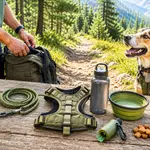
A free printable dog emergency ID card you fill in and print in about a minute. A collar tag holds two lines. This holds everything the tag cannot: who to call, who your vet is, what your dog reacts to, and which emergency clinic is nearest the trail you are on today.
Ready to print
One sheet, two pieces
Cut out both cards. Put one in your own pack and one in your dog's pack. The two of you can be separated, and often are. Laminate them, or use a freezer bag.
Two copies of this card print, so one goes in each pack.
The details sheet
Prints under the cards, for a vet or a rescuer. Anything you left blank is left off.
This card carries information you entered. It is not veterinary advice and states no dose, no limit and no safe threshold. In an emergency, call the vet.
Why a card, when your dog is already chipped
A microchip is not a tracker. As the American Kennel Club puts it, you cannot follow your dog using the chip, and reading one needs a scanner that a hiker on a ridge does not have. A card works in the hands of whoever is actually standing there.
There is a second case people plan for less often: the one where you are the one who gets hurt. The AKC’s own emergency form opens by asking who would care for your dog if you could not, and it tells you to put the finished sheet on your refrigerator. That is the right question kept in the wrong place. This tool moves it into your pack.
It matters because rescue teams differ on what happens to the dog. Some state plainly that they are there for people, not for carrying out an exhausted or injured dog, and there are documented rescues where an injured hiker was flown out and the dog was left on the mountain. A card in your own pack is what lets someone else make that call properly.
Two decisions we made for you, and why
- There is no field for your street address. A card dropped on a trail carrying your name, your home address and the date you are back tells a stranger the house is empty. City and state is enough for anyone who needs it.
- The microchip number is safe to print. Entering a chip number into the AAHA lookup tool returns only the registries that hold a record, along with their contact details. It is a directory, not a database of owners. A stranger with the number learns which company to phone, not who you are or where you live.
- Your dog’s name is your call. The AKC lists it first. Some owners leave it off so a stranger cannot call the dog over by name. We turn it on by default and leave the field empty-able, because the argument for leaving it off is widely repeated but thinly sourced.
This tool does not plan your trip
The trip section here is deliberately short. A proper plan left with someone at home is a different document, and the Washington Trails Association itinerary template already does it well, down to your boot size and the colour of your tent. Use theirs for the hike. Use this for the dog, which is the part theirs leaves out.
The American Kennel Club's own emergency form asks for the dog's name, sex and date of birth, your veterinarian's name, address and phone number, diet, allergies, medication instructions, and two or three people who have agreed to take the dog. For a card you carry on a hike, add the microchip number and the emergency vet nearest your route. No. As the AKC puts it, you cannot track a dog using the chip because it is not a GPS device, and reading one needs a scanner that a hiker on a ridge does not have. A printed card works in the hands of whoever is actually standing there. Yes. Entering a chip number into the AAHA Universal Pet Microchip Lookup returns only the list of registries that hold a record, along with those registries' contact details. The tool is a directory, not a database of owners, and it stores no owner contact information. A stranger with the number learns which company to phone, not who you are or where you live. That depends on the rescue team, and the policies differ. Some state plainly that they are there to help people in emergencies rather than to carry out a tired, dehydrated or injured dog, and some will only recover a dog whose location is known. In one documented case in New Zealand, rescuers evacuated a badly injured hiker without her dog because it could not be found. A card in your own pack is what tells rescuers the dog exists, what it looks like, and who has agreed to take it. The AKC lists the dog's name first on both its tag advice and its emergency form, because it lets a finder speak to the dog. Against that, a number of pages argue that a name helps a stranger call the dog over. Those pages are retailer blogs rather than authorities, so the field is on by default here and you can leave it blank if you prefer. No, and this tool does not ask for one. A card dropped on a trail carrying your name, your home address and the date you are due back tells a stranger the house is empty. City and state is enough for anyone who genuinely needs it.Common questions
What should be on a dog ID card?
Is a microchip enough on its own?
Is it safe to print my dog's microchip number?
What happens to my dog if I am injured while hiking?
Should I put my dog's name on the card?
Should I put my home address on it?
We never see any of this
The card is built entirely inside your browser. Nothing is uploaded, nothing is saved on our side, and none of it is ever written into the web address. There is no account and no email required. Close the tab and it is gone, unless you tick the box to keep it on your own device, which you can clear at any time.
Next, build the list of what goes in the pack with the packing checklist, or go back to all free tools.