Some links on this page are affiliate links. If you buy through them we may earn a small commission, at no extra cost to you. See our Affiliate Disclosure.
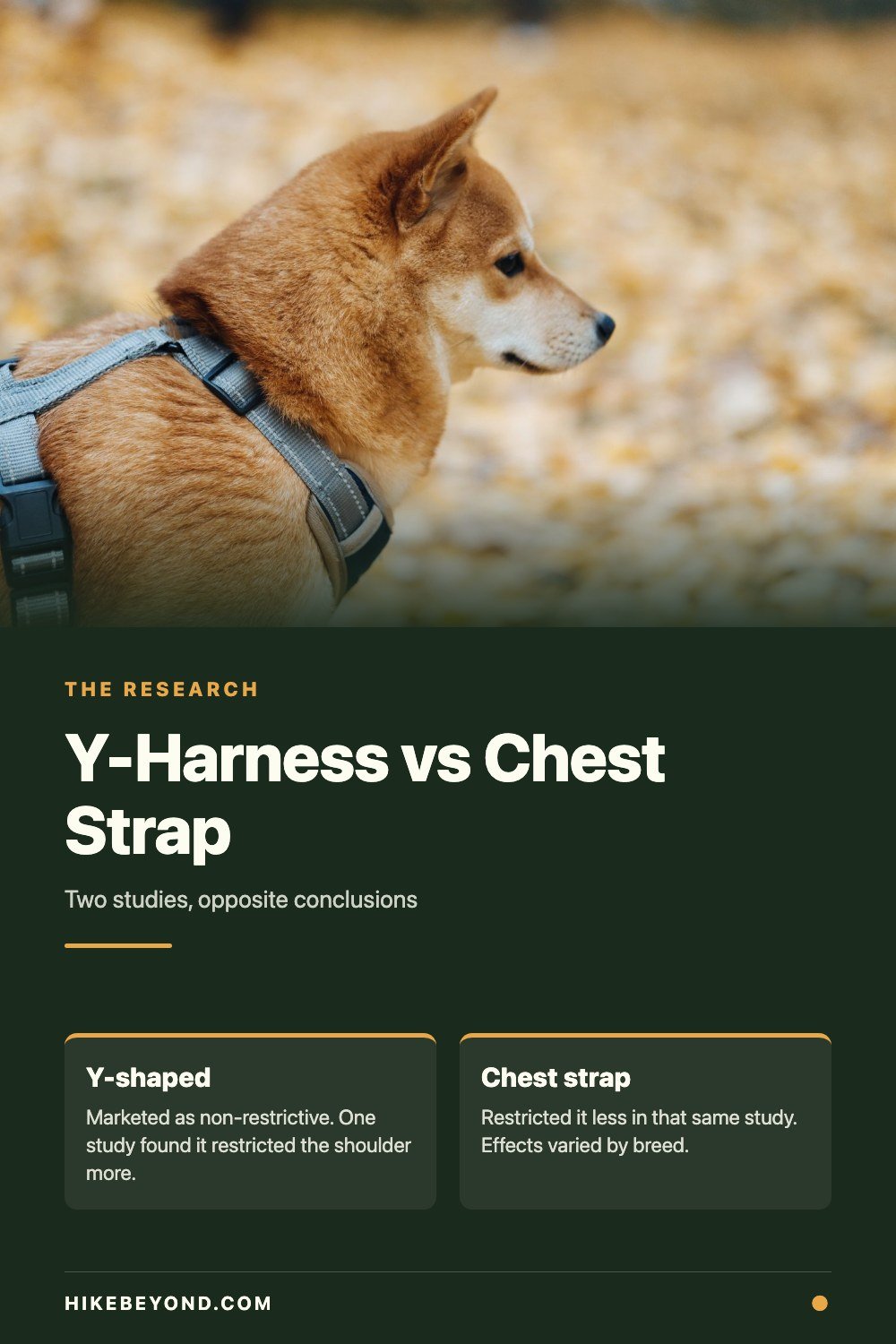
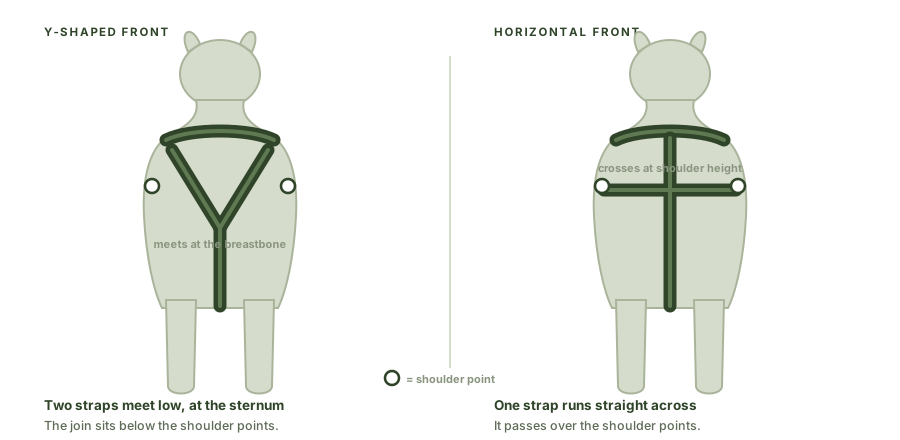
Search for a dog harness and you will be told that Y-shaped designs are “non-restrictive” and that chest-strap designs damage your dog’s shoulders.
That claim is repeated everywhere. The research behind it is thinner, and more contradictory, than the marketing suggests.
What is on this page
So which one is better?
The honest answer: the evidence does not clearly favour either shape. Two studies reached opposite conclusions, and the larger of them found that effects varied by breed.
What both point to is the same practical conclusion, fit and strap position matter more than the shape on the label. A well-fitted chest-strap harness is very likely better for your dog than a poorly fitted Y-harness, whatever the packaging says.
Below is what each study actually measured, and then how to judge a harness on the dog in front of you.
What the research found
Three pieces of published work matter here.
| Study | What it found |
|---|---|
| Lafuente et al., 2018 Small, treadmill | Both harnesses restricted shoulder extension. The Y-shaped “non-restrictive” harness restricted it more, up to 10° versus up to 8° for the chest strap |
| Systematic review, 2019 3 papers total | Only one provided reliable gait data. Small samples, no long-term data linking harness use to injury |
| Applied Animal Welfare Science, 2023 66 dogs | Significant differences between harnesses in stride length and weight distribution. Effects varied by breed. Authors recommended treating dogs individually |
The finding that surprises people
Lafuente and colleagues measured shoulder extension in dogs walking and trotting. The harness marketed as non-restrictive reduced shoulder extension by an additional 2.56° at walk and 4.82° at trot compared with the chest-strap design.
In other words, in that study the “non-restrictive” harness was the more restrictive one.
Do not over-read this. It was a small preliminary study on a treadmill. The 2019 systematic review that examined it was explicit that the evidence base is thin: three papers in total, only one with reliable gait data, and none linking harness design to actual musculoskeletal injury over time.
The larger, more recent study
The 2023 study filmed 66 dogs walking on a loose lead across a pressure-sensing gait analysis system, comparing three commercially available harnesses.
It found significant differences in stride length and in how weight was distributed between front and hind limbs. Differences at one shoulder measurement point were not statistically significant.
Most usefully, it found that the effects differed depending on breed and body type, and the authors’ own recommendation was that owners and fitters “treat dogs on an individual basis.”
Why the label does not decide it
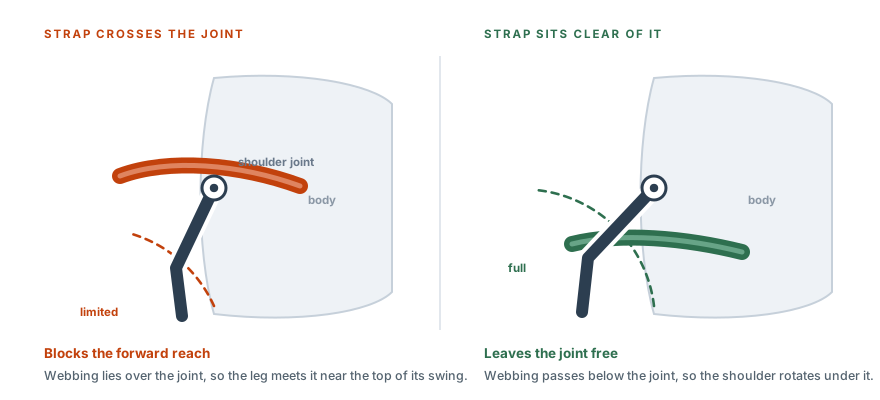
A harness restricts movement when a strap crosses the path the shoulder needs to travel. Whether it does that depends on where the strap actually sits on your dog, which is a function of fit, adjustment and body shape, not the category name on the box.
Two dogs in the same model of harness can have completely different strap positions if one is deep-chested and the other is not.
This is why fit beats shape. A Y-harness adjusted so the front strap rides across the shoulder joint is restrictive. A chest-strap harness sitting low and clear of the joint may not be.
How to judge a harness on your own dog
This is the part that is actually within your control. None of it requires equipment.
The static check
- Slide your fingers flat under each strap: the AKC suggests about one finger on a small dog, two on a large breed
- The harness does not shift or rotate when you push it gently side to side
- No strap sits directly across the point of the shoulder
- Nothing presses into the armpit
- Your dog cannot back out of it
The moving check
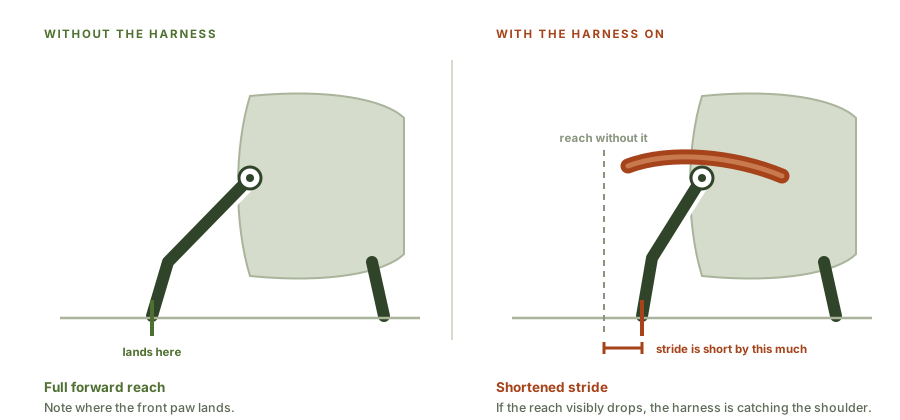
Static fit tells you less than movement does. Walk your dog on a loose lead and watch from the side.
| Look for | What it suggests |
|---|---|
| Front legs reaching the same distance forward as without the harness | Good clearance |
| A shortened, choppier front stride | Something is catching |
| The harness sliding backwards as the dog walks | Too loose |
| Fur parted or flattened in a line after a walk | Pressure point |
| Rubbing or redness at the armpit after a longer outing | Wrong position or too tight |
The most useful test is the simplest one. Watch your dog walk without the harness, then with it. If the front stride visibly shortens, that harness is restricting the shoulder, regardless of what shape it is.
What to look for when buying
Since shape is not the deciding factor, judge on the things that are:
- Adjustment points. At least two, so chest and girth can be set separately. More adjustment means more chance of clearing the shoulder on your particular dog.
- Strap position you can actually change. A harness with fixed geometry either fits your dog or it does not.
- A back handle, useful for helping a dog over an obstacle.
- A rear leash attachment for trail use.
- Reflective detailing if you hike in low light.
What not to pay extra for: the words “non-restrictive” or “ergonomic” on the packaging. On current evidence those claims are not reliably meaningful.
When the shape does matter
A few situations where design genuinely changes the decision:
| Situation | What to favour |
|---|---|
| Dog pulls hard | Front-clip or dual-clip, for control, a separate question from shoulder mechanics |
| Deep-chested breed | More adjustment points; girth and chest need setting independently |
| Short-legged, long-backed breed | Strap position matters more, because there is less room to clear the shoulder |
| Existing shoulder or joint problem | Ask your vet before choosing. This is outside what a buying guide can answer |
Common questions
Is a Y-harness actually non-restrictive?
Not necessarily. In the one study that measured it directly, a Y-shaped harness marketed as non-restrictive reduced shoulder extension slightly more than a chest-strap design. A larger 2023 study found effects varied by breed. “Non-restrictive” is a marketing term, not a verified property.
Will a harness damage my dog’s shoulders?
No study has yet linked harness design to actual injury. Research has measured short-term changes in gait, and researchers have raised the possibility that repeated changes could matter over time, but that connection has not been demonstrated. If your dog has an existing joint problem, ask your vet rather than relying on a buying guide.
Should I use a collar instead?
For many dogs a collar works fine as a leash attachment, and it carries the ID tag either way. A harness becomes the better option if your dog pulls, because it spreads leash force over a larger area than the neck. See Dog Hiking Gear Essentials.
How tight should the harness be?
As a starting point, about one finger under the straps on a small dog, or two on a large breed, without it being loose enough to shift or rub. Always follow the manufacturer’s fitting guide for the specific model.
Does this apply to all breeds equally?
No, and that is one of the clearer findings. The 2023 study found the effects of harness design varied by breed and body type, which is why its authors recommended assessing each dog individually rather than following a general rule.
Continue exploring
Dog Hiking Gear Essentials
Small Dog Harnesses That Actually Fit
Dog Backpack Fitting Guide
Hands-Free Leashes: Are They Worth It?
Sources
- Lafuente, Provis & Schmalz, Effects of restrictive and non-restrictive harnesses on shoulder extension in dogs at walk and trot (2018). The 8° vs 10° shoulder extension finding. Record
- A Systematic Review of the Biomechanical Effects of Harness and Head-Collar use in Dogs (2019). The size and limitations of the evidence base. bioRxiv
- Effect of harness design on the biomechanics of domestic dogs (Canis lupus familiaris) Journal of Applied Animal Welfare Science, 2023. The 66-dog study, breed variation, and the recommendation to assess dogs individually. Record
- American Kennel Club, Dog Harnesses and Dog Collars: Which Is Right For Your Dog? Fit sizing, collar versus harness.
HikeBeyond is an information resource, not veterinary advice. If your dog has an existing joint, muscle or mobility problem, consult your veterinarian before choosing a harness.
Save this for later
Pin this to come back to it, or to send it to someone heading out with a dog.