Some links on this page are affiliate links. If you buy through them we may earn a small commission, at no extra cost to you. See our Affiliate Disclosure.
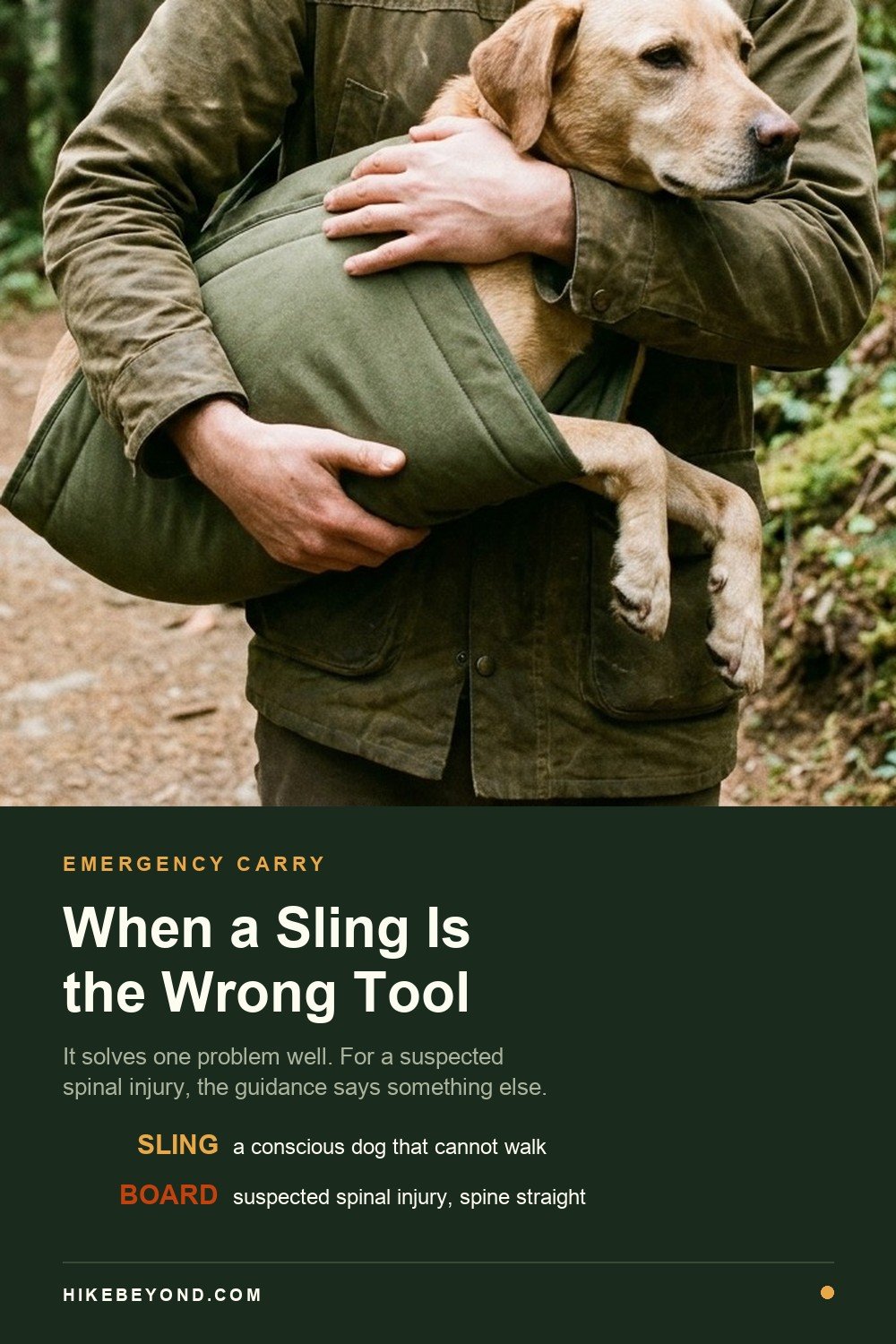
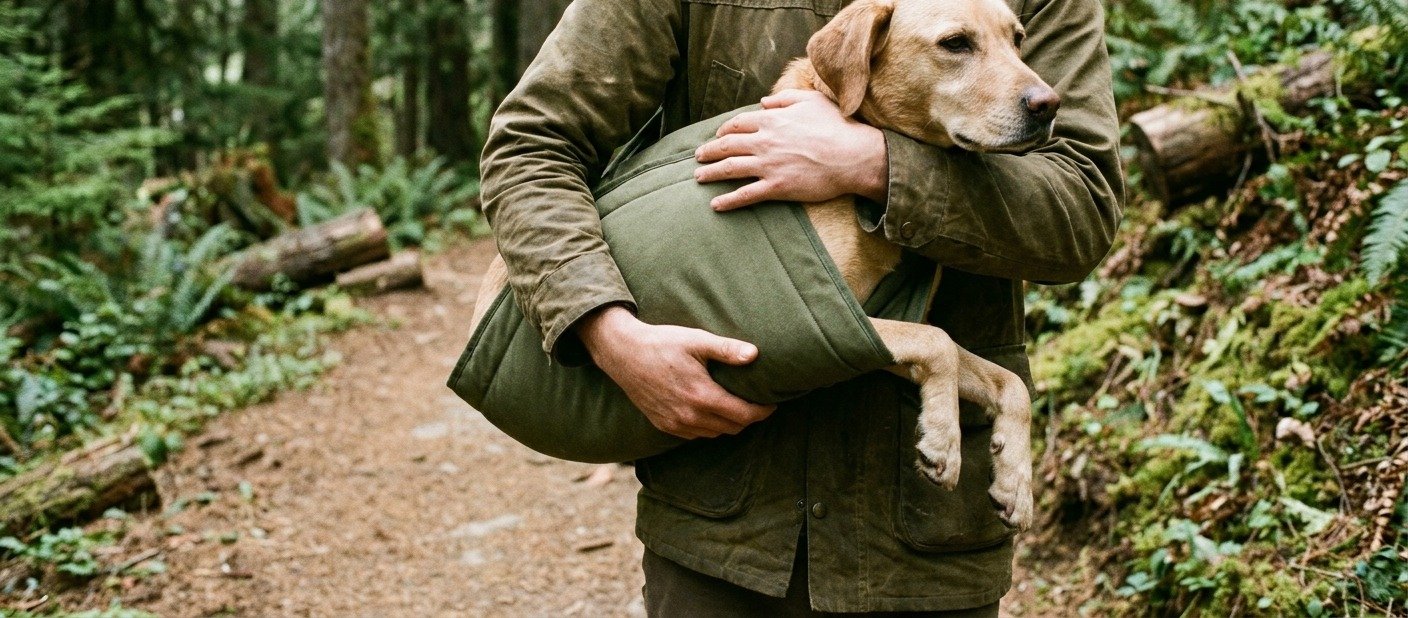
Carrying a large dog out of the backcountry in your arms is close to impossible over any distance. A rescue sling turns that into a manageable carry, packs down small, and weighs very little.
It is genuinely useful equipment. It is also the wrong tool in one specific and important situation, and product pages do not tell you which one.
What is on this page
What is a rescue sling for?
A conscious dog that cannot walk, where there is no suspected spinal or back injury. A torn pad, an exhausted dog, a sprain, a leg your dog will not put weight on, a sling lets you get that dog back to the trailhead.
Not for a suspected spinal injury. Veterinary transport guidance for a dog with a suspected back or neck injury is to immobilise it on a sturdy flat surface such as a board, keeping the spine straight and preventing any twisting.
A sling does the opposite. It suspends the dog, so the spine can flex and rotate as you walk. That last part is reasoning from how the equipment works rather than a measured finding, but it is why the two are not interchangeable.
This is the distinction to remember. Sling for a dog that cannot walk. Rigid flat support for a dog that might have injured its spine. Using the first where the second is needed can make an injury worse.
How to tell the difference
You are not diagnosing, you are deciding how to move a dog. Veterinary guidance treats a spinal injury as suspected when a dog is paralysed or unable to get up at all. An unconscious dog gets the same treatment: immobilise on a flat support and keep the head in normal alignment, neither flexed down nor extended up.
| Situation | Move with |
|---|---|
| Limping, will not weight-bear on one leg, exhausted, cut pad | Sling |
| Cannot stand or move the hind legs at all | Rigid flat support: improvise, do not sling |
| Unconscious | Rigid flat support, and treat as an emergency |
| Fell from height, or hit by something at speed | Assume possible spinal injury until a vet says otherwise |

Improvising a rigid support in the backcountry means a piece of board or anything else firm and flat that will hold the dog’s weight, or a blanket carried taut by two people. Keep the dog on its side, avoid twisting the body, and secure it if you can.

If you are unsure which category you are in, phone a vet before you move the dog. Guidance by phone costs nothing and may change what you do.
One more thing before you lift
An injured dog may bite. AKC guidance notes that pain and fear cause defensive behaviour even in dogs that have never shown it, and suggests a muzzle may be appropriate during transport.
With an important exception: never muzzle a dog that is vomiting: the choking risk outweighs the bite risk.
Teaching a dog to accept a muzzle calmly, before it is ever needed, is the sort of thing that is easy in a quiet moment and impossible in an emergency.
Do you actually need one?
Honestly, many people do not. It depends on two things.
| Sling is worth carrying | Probably not | |
|---|---|---|
| Dog size | Anything you could not comfortably carry in your arms for a mile | Small dog you can lift and carry |
| How remote | Miles from the trailhead, rough ground, poor phone signal | Short loops near the car park |
A 15 lb dog on a suburban trail does not need one, you can carry that dog. A 70 lb dog four miles out on rocky ground is the scenario the product exists for.
The question is not “could my dog get hurt?” It is “if my dog could not walk, how would I get it out from the furthest point of my usual route?” If the honest answer is that you could not, that is what the sling is for.
What to look for
- Packed size and weight. These vary considerably between designs, check the specification rather than assuming. A sling you leave at home because it is bulky protects nobody.
- Deployment speed. Practise it once at home. Something you have never opened is slower than the packaging suggests.
- Weight rating matched to your dog, with margin.
- Load distribution across your own body. You may be carrying this for a long way over bad ground. Shoulder straps beat a hand carry.
- Support under the chest and abdomen rather than a single narrow band.
- Usable alone, if you often hike alone. Some designs assume two people.
What not to pay extra for: claims about being usable in every emergency. As above, there is a category of injury where it is the wrong choice.
Practise it once
The failure mode is not the equipment. It is a person trying to work out an unfamiliar system while a distressed dog is in pain and the light is going.
- Unpack and deploy it at home, in daylight, with your dog relaxed
- Fit it to your own body, adjusted for your torso
- Do a short carry so you know what the weight is like
- Repack it the way you will carry it
- Show anyone you hike with regularly how it works
Ten minutes, once. That is the whole training requirement.
Common questions
Can I use a rescue sling for any injury?
No. It is for a conscious dog that cannot walk without a suspected spinal or back injury. Veterinary transport guidance for suspected spinal injury is a rigid flat support with the spine kept straight and untwisted, a sling allows exactly the movement that guidance is trying to prevent.
How do I know if it is a spinal injury?
You do not diagnose it, you assume it. If the dog cannot stand or move its hind legs, is unconscious, or has fallen from height or been hit at speed, treat it as a possible spinal injury and use a rigid support. Phone a vet before moving the dog if you can.
Is a sling worth it for a small dog?
Usually not. If you can carry your dog in your arms for a mile over rough ground, you are already equipped. The product exists for dogs you cannot.
Can I improvise one?
Yes, and the guidance describes how. For a dog that is struggling to walk but still moving, AKC suggests passing a blanket under the abdomen and lifting, which takes the weight off a sore or injured leg while the dog walks itself out. For a dog that cannot walk at all, the same blanket becomes a stretcher, with the edges rolled for grip, and that is usually a two-person job. For a suspected spinal injury it has to be a rigid flat support instead, and improvising that is expected.
Should I muzzle my dog before carrying it?
It may be appropriate, pain and fear cause defensive behaviour even in gentle dogs. But never muzzle a dog that is vomiting, because of the choking risk. Teaching muzzle acceptance in advance is far easier than attempting it during an emergency.
Continue exploring
Sources
- American Kennel Club, How to Transport an Injured or Sick Dog to the Veterinary Hospital a makeshift stretcher on a sturdy flat object such as a board for a dog that cannot stand, with the stated goal of preventing twisting of the neck and back, the blanket under the abdomen for a dog still able to walk, muzzling guidance and the vomiting exception. Note it is the VIN source below, not this one, that ties a flat support specifically to a suspected spinal injury.
- Veterinary Partner (VIN), Transporting an Injured Pet: First Aid backboard immobilisation for a paralysed or unable-to-rise dog, head positioning for an unconscious dog, and the two-person blanket-as-stretcher method.
HikeBeyond is an information resource, not veterinary advice. A dog that cannot stand, is unconscious, or may have injured its spine needs veterinary attention, contact a vet.
Save this for later
Pin this to come back to it, or to send it to someone heading out with a dog.