Some links on this page are affiliate links. If you buy through them we may earn a small commission, at no extra cost to you. See our Affiliate Disclosure.
Most dog harnesses advertise reflective stitching, and most owners assume that covers them for an evening walk.
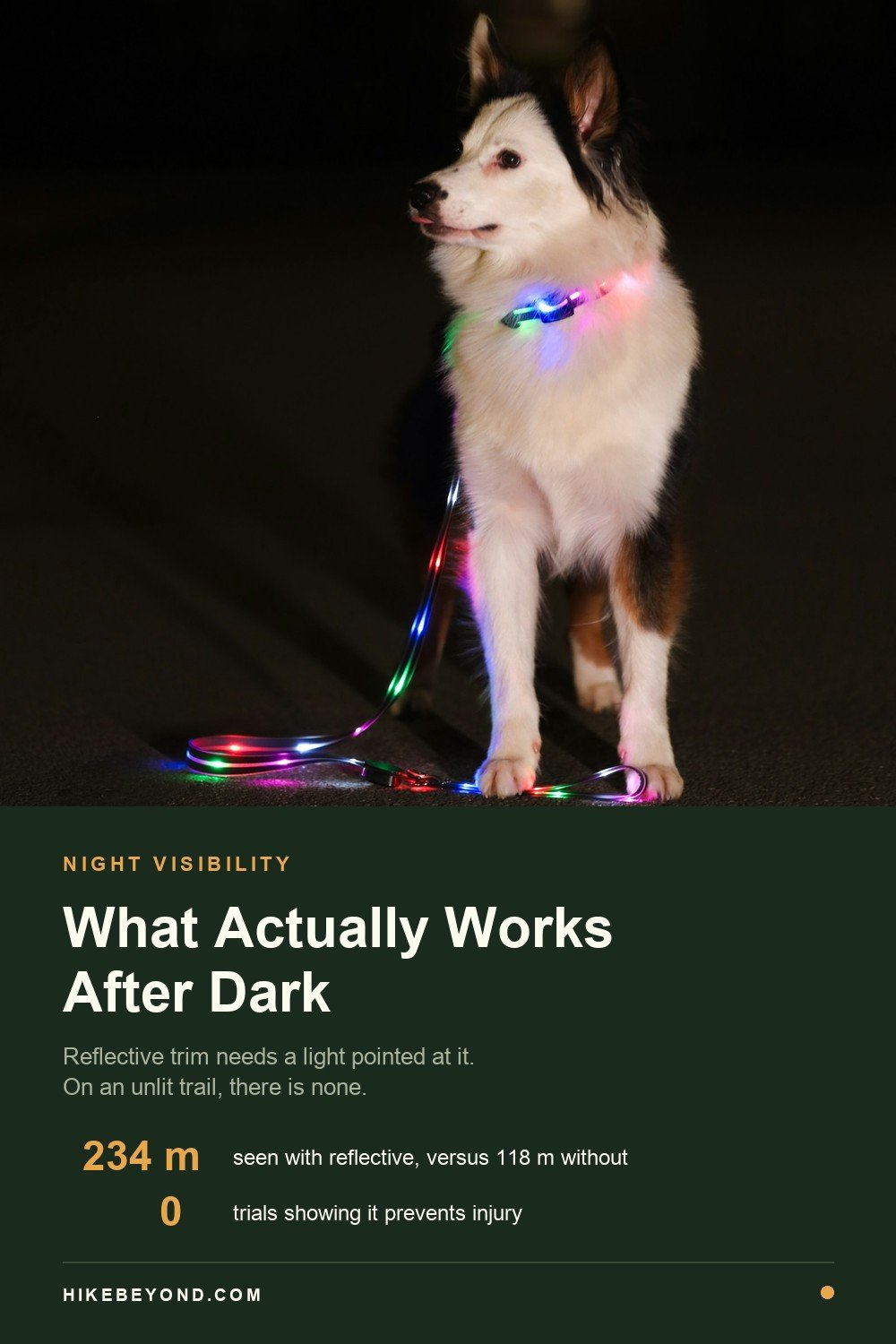
Reflective material is genuinely effective, but only when something is shining light at it. On an unlit trail at dusk, often nothing is.
What is on this page
Reflective or a light, which does my dog need?
On a road or path with traffic: reflective helps, because headlights supply the light.
On an unlit trail: you need an active light. Reflective material returns light to its source. With no headlights and no torch pointed at your dog, there is nothing to return.
The two solve different problems, and a harness with reflective trim has not solved the trail one.
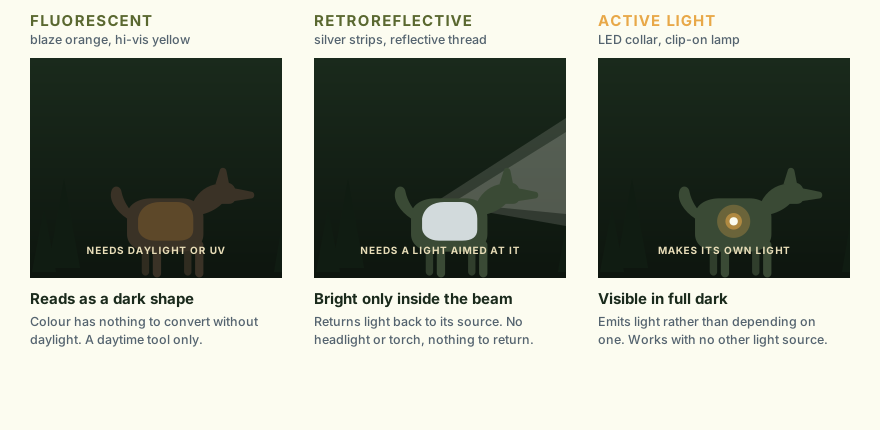
Three different technologies, commonly confused
This distinction is rarely explained and it decides what you should buy.
| Type | How it works | When it works |
|---|---|---|
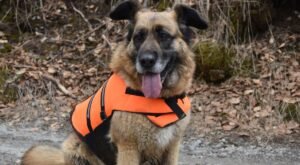
| Fluorescent (blaze orange, hi-vis yellow) | Converts UV into visible light, appearing unnaturally bright | Daylight and twilight only. Does nothing in the dark |
| Retroreflective (silver strips, reflective thread) | Returns light straight back toward its source | Only when a light shines on it: headlights, a head torch |
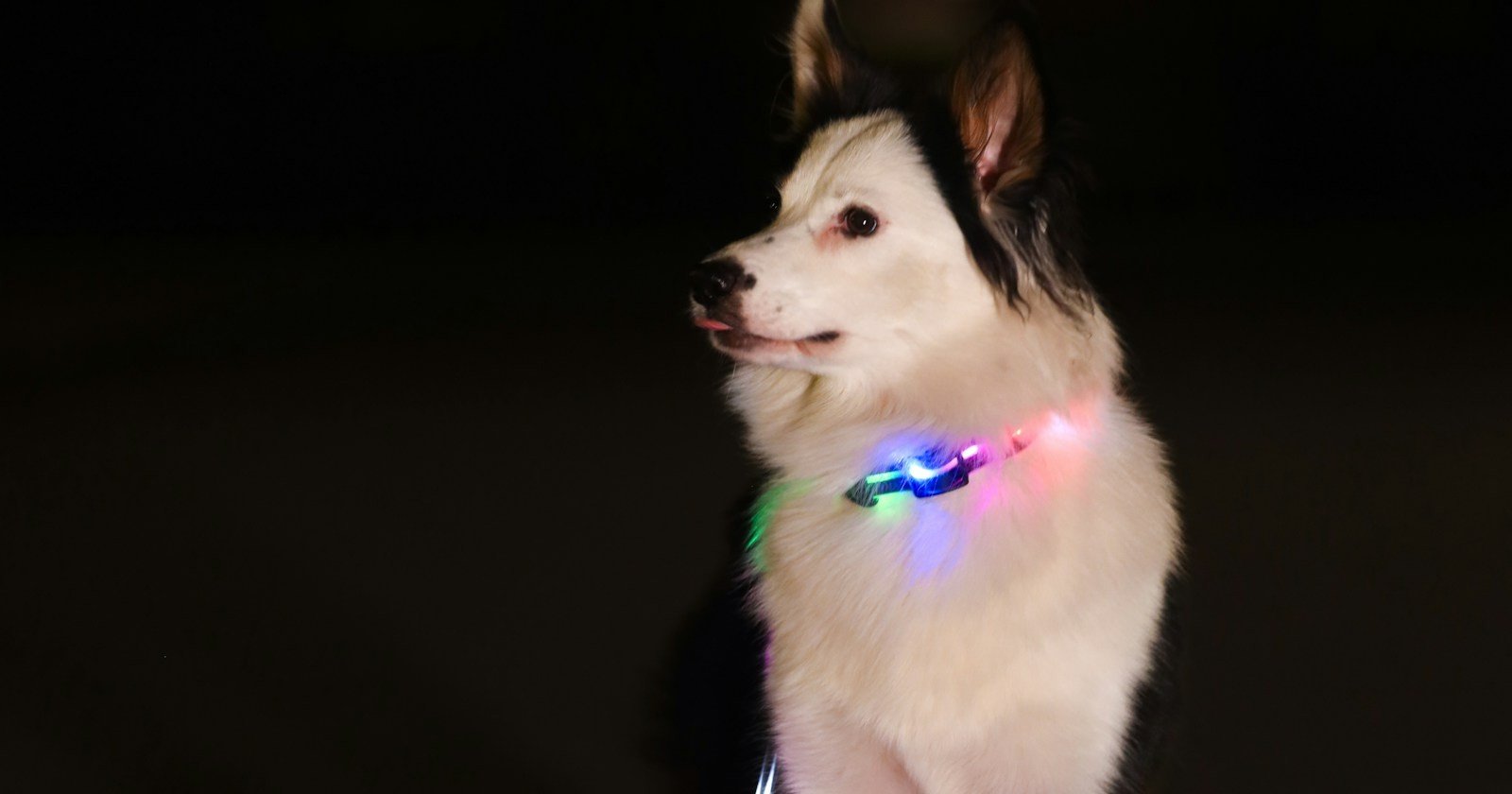
| Active light (LED collar, clip-on lamp) | Emits its own light | Any conditions, including full dark |
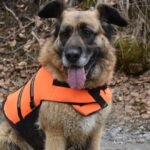
Blaze orange does nothing at night. It is a daylight tool, the right one for hunting season, the wrong one for a dusk walk. Two different problems.
What the research shows
A Cochrane review of visibility interventions for pedestrians and cyclists found:
- Fluorescent materials in yellow, red and orange improve detection and recognition in daytime
- Lamps, flashing lights and retroreflective materials in red and yellow increase detection at night
- “Biomotion” markings: retroreflectors positioned on the major joints, showed particular promise
On distance, one study found a reflectorised jacket was visible at 234 m versus 118 m without. A separate study found pedestrians wearing retroreflectors on the ankles and wrists were recognised at 113.5 m, versus 25 m for a single reflective patch on the torso alone.
The honest limitation
Improved detection is not the same as proven safety. The review identified 42 trials measuring driver responses, but no trials measuring whether visibility aids actually reduce collisions and injuries. That gap is the review’s most significant finding.
It also noted something that applies directly here: people consistently overestimate their own visibility. The reflective trim on a harness feels like protection. At dusk on an unlit trail, it may be doing very little.
And a caveat about transferring it
This research is about drivers seeing people. There is no equivalent body of work on seeing dogs on trails. The reasoning below follows from how the technologies work, not from studies on dogs, worth stating plainly rather than implying more certainty than exists.
Why biomotion matters for a dog
The joint-marking finding is the most interesting part, and it transfers well.
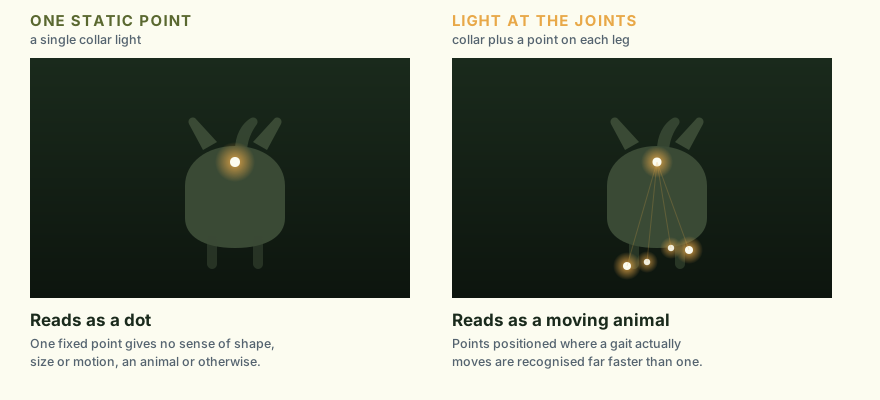
Human observers identify a moving living thing far faster from motion at the joints than from a single static point of light. That is the biomotion effect.
A dog is a small, low, fast-moving shape. A single light on the collar reads as one dot. A dog whose movement is visible reads as an animal.
In practice: a light or reflective material that moves with the dog’s gait gives more information than a static point. A collar light plus reflective material lower on a harness does more than either alone.
What to look for in a dog light
- Steady and flashing modes. Flashing draws attention; steady is easier to track and less irritating on a long walk. Having both is useful.
- Rechargeable, unless you are certain about carrying spare batteries.
- Genuinely waterproof, not “water resistant”, dogs go into water and rain.
- Secure attachment that will not be pulled off in undergrowth.
- Visible from behind and the sides, not only from the front. A dog that ranges ahead is most often seen from behind.
- Light weight, especially on a small dog.
What not to pay extra for: lumen ratings. You are marking a position, not lighting a path. Brightness beyond visible-at-distance adds nothing and can dazzle you.
A sensible setup
| Conditions | What works |
|---|---|
| Daylight, hunting season | Fluorescent, blaze orange vest |
| Dusk on a road or path | Reflective + a light |
| Dusk or dark on an unlit trail | Active light, essential. Reflective adds little without a light source |
| Night, dog off-leash where permitted | Active light, ideally visible from all sides |
| Your own head torch | Makes the dog’s reflective material work again, worth remembering |
Your head torch changes the maths. If you are wearing one, reflective material on your dog suddenly does work, for you. It still does nothing for anyone approaching from another direction.
Common questions
Is reflective material enough for night walks?
On a road with traffic, it helps, because headlights provide the light it needs. On an unlit trail there is often no light source, so it returns nothing. An active light is what works in the dark.
Does blaze orange work at night?
No. Fluorescent colours work by converting UV light, which means they are a daylight and twilight tool. For hunting season visibility in daylight they are the right choice, see Blaze Orange for Hunting Season. After dark they do nothing.
Flashing or steady?
Flashing attracts attention more readily; steady is easier to track and less distracting over a long walk. Many lights offer both, which is the practical answer.
Do these lights actually prevent accidents?
Nobody has shown that. The Cochrane review found 42 trials on how quickly drivers detect people, and none measuring whether visibility aids reduce collisions and injuries. Better detection is a reasonable goal; proven injury prevention is not something the evidence supports yet.
Where should I put the light?
Somewhere visible from behind and the sides, since a dog ahead of you is most often seen from behind. If you can add reflective material lower on the body as well, movement at the legs is detected faster than a single static point.
Continue exploring
Sources
- Interventions for increasing pedestrian and cyclist visibility for the prevention of death and injuries, Cochrane review. PMC8713592, fluorescent in daylight, lamps and retroreflective at night, biomotion, and the absence of trials on injury outcomes.
HikeBeyond is an information resource. Visibility research on humans and vehicles is applied here by reasoning, not by direct study of dogs on trails.
Save this for later
Pin this to come back to it, or to send it to someone heading out with a dog after dark.