Getting a Dog Ready for the Trail
Everything except the gear, which has its own directory. How to get a dog ready for a trail, how to read the conditions once you are on it, and what the evidence actually supports.
If you are new to this
Most dogs need less equipment than the internet suggests and more preparation than it mentions. Start with what your dog actually needs to carry, then work through fitness, conditions and trail manners.
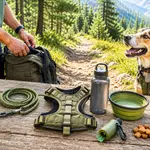
Dog Hiking Gear: What You Actually Need (And What Can Wait)
Six items cover most day hikes. The rest is sorted into what to add as hikes get longer, and what to skip entirely. Includes the fit rule most people get wrong: about one finger under the straps on a small dog, two on a large breed.
Read the guidePreparation that happens at home
The decisions that matter most are made before anyone reaches a trailhead.
Fitness and pacing
A dog will usually keep going past the point where it should stop, which puts the judgement on you. Build distance gradually, and plan the return leg as carefully as the outward one.
Guide in progressKnow the season and the rules
Rules vary by state, by species and by weapon, and they differ again between state forest, national forest and national park. In National Park Service areas a leash may not exceed six feet.
Recall, and when it is not enough
Reliable recall changes what is safe to attempt. It does not override a leash requirement, and most trails that permit dogs still require one.
Guide in progressReading the conditions
Heat, ground surface and other trail users are the three things most likely to turn a good day into a short one.
Heat and water
Dogs shed heat by panting rather than sweating, so they manage heat differently from you, and flat-faced breeds differ again. Carry water for the dog rather than relying on what you find.
Guide in progressPaws and terrain
Sharp rock, hot surfaces, snow and ice are the conditions that cause most paw trouble. Many dogs manage ordinary dirt trails without any protection at all.
Guide in progressTrail manners
Bag the waste and carry it out, keep the dog leashed, respect wildlife, and know where you are. Those are the four principles the American Kennel Club summarises as B.A.R.K.
Guide in progressThree findings worth knowing
Each of these comes from a published source, and each one changed how the guide beneath it was written.
Every guide on this site
Four published, with more added on a regular schedule. Nothing is listed here until it exists.
Dog Hiking Gear: What You Actually Need (And What Can Wait)
The starting point. Three tiers: what you need on hike one, what to add as hikes get longer, and what to skip.
Read the guideY-Harness vs Chest Strap: What the Research Actually Says
The marketing says Y-shaped harnesses are non-restrictive. One study found the opposite. What the three papers actually measured, and why fit matters more than the shape on the label.
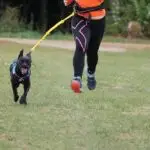
Read the guideHands-Free Leashes: What the Injury Data Actually Suggests
The most common dog walking injury treated in US emergency rooms is a broken finger. What that means for going hands-free, and the one feature that is not optional.
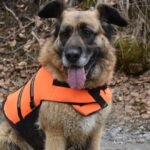
Read the guideBlaze Orange for Dogs: What Hunting Season Actually Needs
The risk to hikers is genuinely low, and the fix costs very little. How to find your firearm deer season dates, which is the part every other article leaves out.
Read the guideDog LED Lights vs Reflective: Which Works After Dark?
Reflective trim only works when something shines light at it, and on an unlit trail nothing does. What the visibility research found, including the honest gap: plenty of trials on whether drivers notice you, none on whether it prevents injury.
Read the guideDog Rescue Slings: When They Help, And When They Don’t
A sling gets a conscious dog that cannot walk back to the trailhead. For a suspected spinal injury, veterinary guidance says the opposite: a rigid flat support with the spine kept straight. Product pages do not tell you which situation you are in.
Read the guideWhat you will not find here
HikeBeyond is a research resource, not a review blog. That means some things are deliberately absent.
- No invented field testing. Nothing here claims a product was tested on a trail, because it was not.
- No unsourced numbers. Every temperature, distance, weight limit and statistic traces to a published source, or the sentence is cut.
- No manufactured certainty. Where the evidence is thin or contradictory, the guide says so. Two of the four guides above reach a partly undecided conclusion, because that is what the research supports.
- Not veterinary advice. This is information for planning. Anything concerning your dog’s health belongs with your veterinarian.