Some links on this page are affiliate links. If you buy through them we may earn a small commission, at no extra cost to you. See our Affiliate Disclosure.
Autumn is the best hiking of the year. It is also when the woods fill up with people carrying rifles, and when most hikers realise they have no idea when hunting season actually starts where they live.
The honest picture: the risk to hikers is genuinely low. But it costs about the price of a coffee to reduce further, and “check your local hunting season”, the advice every article gives, is useless without telling you how.
What is on this page
What does my dog need during hunting season?
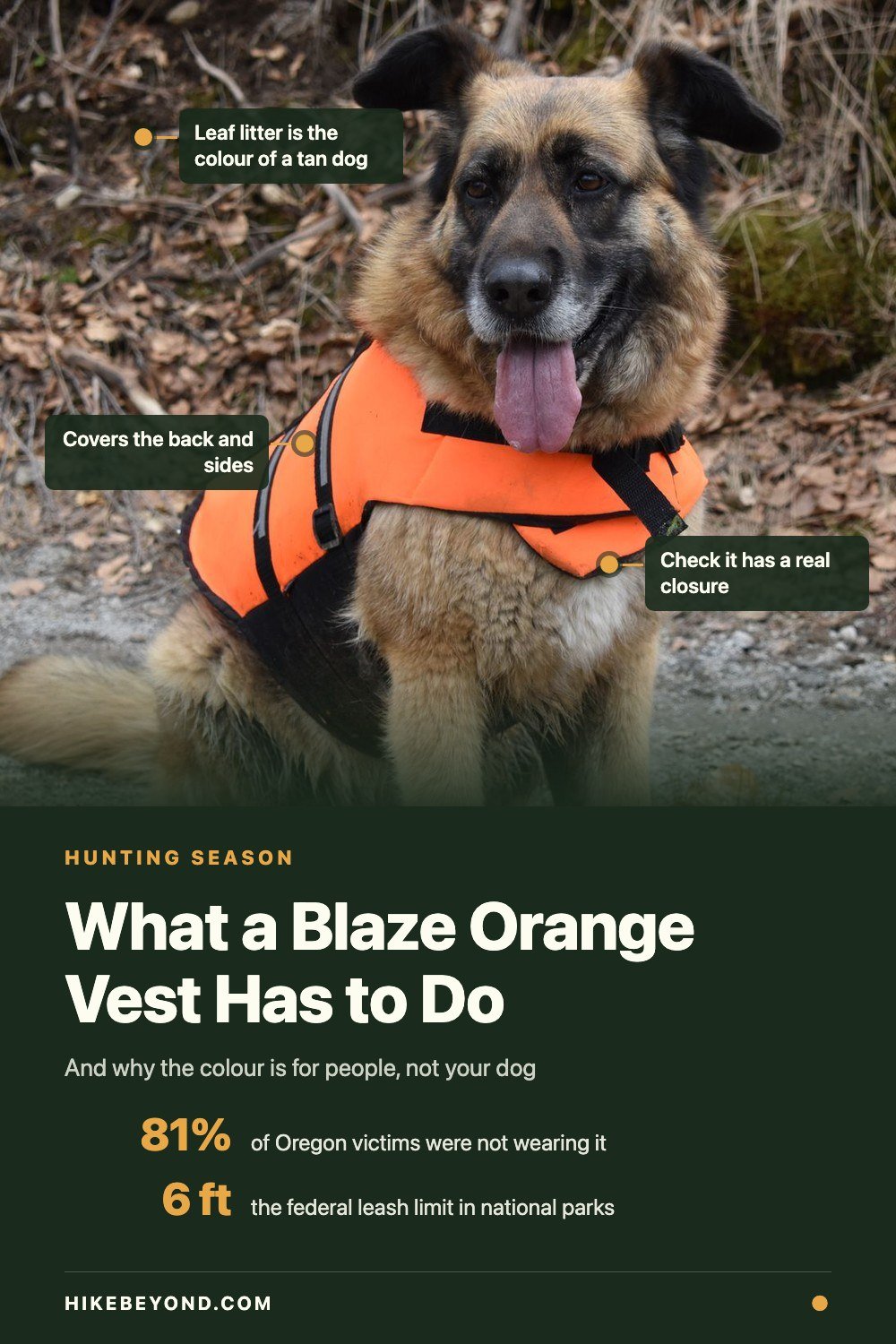
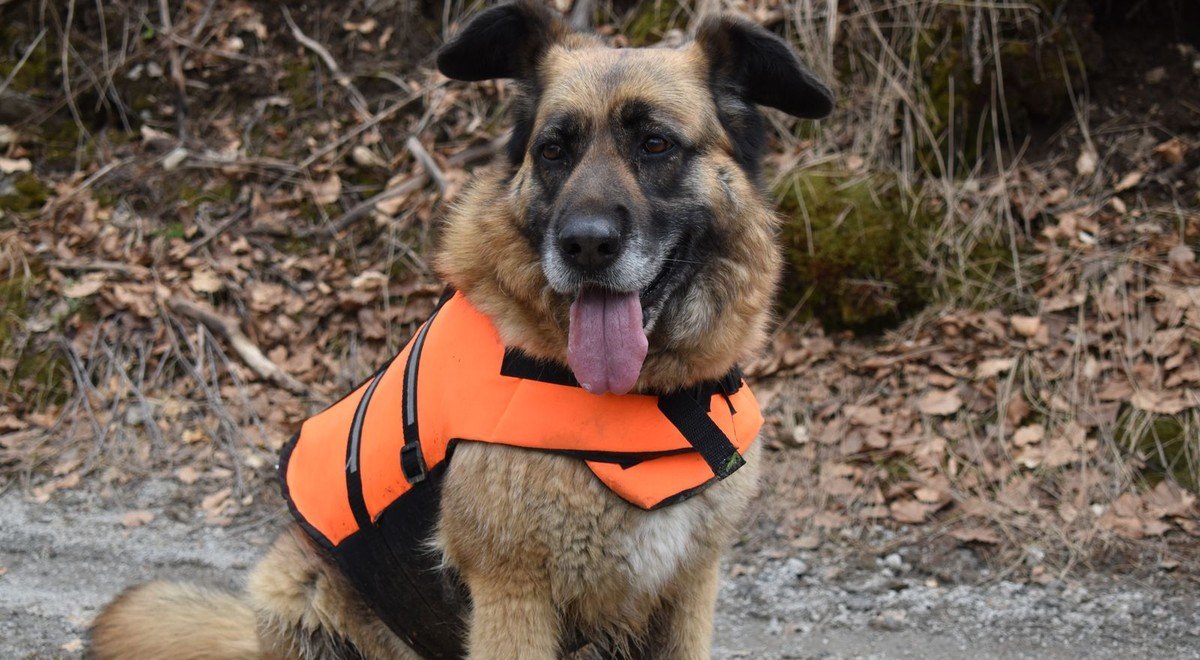
A blaze orange vest or bandana, and a leash. State wildlife agencies consistently recommend putting hunter orange on pets and keeping them leashed and visible during hunting seasons.
Wear orange yourself too. This is the part people skip. Blaze orange is normally a legal requirement only for hunters, but agencies recommend it for everyone in the woods during open seasons.
And know your dates, which is harder than it sounds, and covered below.
The honest risk picture
Two things are true at once, and most articles only tell you one of them.
Incidents involving non-hunters are rare. Massachusetts wildlife officials note that hunting accidents among hunters are already uncommon, and accidents involving non-hunters are rarer still. You are not walking into a war zone.
But visibility demonstrably matters when something does go wrong.
| Finding | Source |
|---|---|
| Hunters wearing hunter orange are seven times less likely to be shot. In the past ten years, nobody wearing it was mistaken for game and killed in New York | New York State DEC |
| Of 86 victims of vision-related hunting incidents in Oregon, 1990 to 2009, only 19% were wearing hunter orange, so 81% were not | Oregon Dept. of Fish and Wildlife |
| None of the victims in Oregon’s vision-related fatal incidents were wearing hunter orange | Oregon Dept. of Fish and Wildlife |
| Of 125 hunters injured after being mistaken for game in New York, 1989 to 1995, 117 (94%) were not wearing hunter orange | Jones 1993, cited by ODFW |
| Across four states that made it mandatory, incidents fell 22% and fatalities 40% per 100,000 hunters | ODFW survey of North Dakota, Texas, Utah, Washington |
That last row hides something, and it matters. The 22% and 40% are a four-state average, not a uniform result. North Dakota’s fatalities fell 82% and Washington’s 47%, but Texas’s fatalities rose 6% after its requirement. A measure can work on average and still not work everywhere.
Orange is not a force field. ODFW is blunt that hunter orange only addresses vision-related incidents, where someone shoots what they failed to identify. It does nothing for the other causes. In Oregon those vision-related cases were 50% of all hunting incidents and 66% of fatalities, so it is a large share, but not all of it. Fading from UV, dirt and poor light reduce how well it works. Treat it as one layer.
One more piece of context that changes how you read all of this: most hunting incidents do not involve a stranger at all. New York recorded seven hunting-related shooting incidents across the whole of its 2025 seasons, none fatal. Five of the seven were self-inflicted, and the other two involved two parties. The numbers above describe hunters shooting themselves or the person they came with, which is a different situation from a hiker on a trail. It is a reason for calm, not complacency.
How to actually find your season dates
Every article says “check local hunting seasons.” Almost none says how. Here is the part that is genuinely useful.
“Hunting season” is not one thing. It varies by state, by species, and by weapon, archery, muzzleloader and firearm seasons for the same animal run at different times, and the firearm deer season is usually the busiest period in the woods.
Where to look:
1. Search [your state] DNR hunting season dates or [state] fish and wildlife. Every state publishes a season calendar. That is the authoritative source, not a blog, not a summary. 2. Find the firearm deer season specifically. If you only track one set of dates, track that one. 3. Check the specific land you are hiking. Rules differ between state forest, national forest, national park and private land. Many national parks prohibit hunting entirely; many national forests allow it. 4. Look for no-hunting days. Some states prohibit hunting on Sundays, or on certain holidays. Those are the safest days to be out.
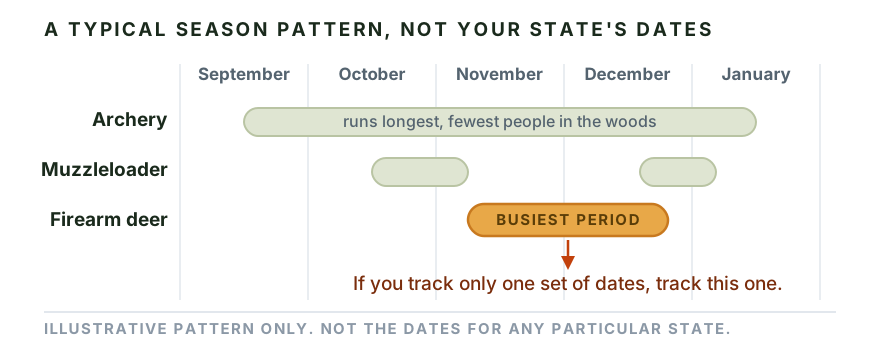
Every state publishes its own calendar, and the same animal has different dates for archery, muzzleloader and firearm. Rules also differ between state forest, national forest, national park and private land, so check the specific place you are going.
Put the firearm season dates in your calendar once a year. It takes five minutes and removes the question permanently.
What the dog should wear
| Option | Notes |
|---|---|
| Blaze orange vest | Best coverage. Look for one that does not interfere with a harness |
| Blaze orange bandana | Cheapest option, better than nothing, less visible from behind |
| Orange leash or collar cover | Useful addition, not a substitute for body coverage |
Coverage matters more than the item. A vest visible from the side and from behind does more than a small patch of colour at the throat.
For a sense of scale, New York requires firearm deer and bear hunters to wear at least 250 square inches of solid fluorescent orange or pink above the waist, visible from all directions. That is roughly the front of a vest. Nothing obliges your dog to match it, but it is a useful benchmark for what “visible” means to the people writing the rules.
The orange is not for your dog, and not for the deer. Dogs are dichromats and can barely distinguish long wavelengths like red and orange, and deer lack red-sensitive cones entirely, which is why hunter orange does not spook game. The vest exists purely so that a human being at distance can tell your dog from an animal. That is also why shape and movement matter as much as colour: put the orange where a person will see it, high on the back and sides.
Think about your dog’s own coat colour
This is worth a moment’s thought. A tan, brown or white dog moving through autumn brush is harder to identify at distance than a black one. Agencies advise avoiding earth-toned and animal-coloured clothing for exactly this reason, and your dog’s coat is not something you can change.
If your dog is a colour that blends into autumn woodland, the vest matters more, not less.
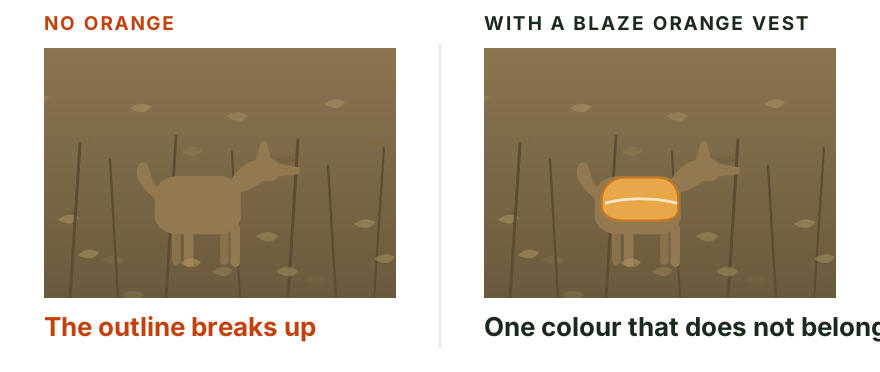
On the left, a tan, brown or white dog is built from the same colours as autumn leaf litter, and bare stems cut across its shape, so at distance there is little left for a human eye to lock onto. On the right, nothing in autumn woodland is that colour. The vest gives the eye a solid block to find, and it covers the back and sides, which are the surfaces seen from a distance.
What you should wear
Easy to forget when you are focused on the dog.
- Blaze orange hat, vest or jacket, visible from all directions
- Avoid earth tones: brown, tan, dark green
- Avoid white entirely during deer season
- Make noise, talk, whistle. Agencies specifically advise identifying yourself as a person rather than moving quietly
- Stay on marked trails
- Consider hiking mid-morning to mid-afternoon; dawn and dusk are the busiest hunting hours and the worst light for identifying a target
Noise is underrated. Hunters listen as much as they look. Quiet movement through brush sounds like an animal; conversation does not.
What orange does not fix
Being clear about the limits is the point of the article.
- Faded or dirty orange is much less visible. Replace a vest that has gone salmon-pink in the sun.
- Low light defeats it. Dawn and dusk are when identification is hardest and hunting activity is highest. Adjust your timing rather than relying on colour.
- It does not replace being on a leash. A dog moving unpredictably through brush at distance is the scenario to avoid entirely.
- Some colour blindness affects orange perception. Another reason not to treat it as absolute.
Common questions
Is blaze orange legally required for my dog?
Generally no. Blaze orange requirements normally apply to hunters, and specific rules vary by state. Agencies recommend it for pets and non-hunters as a precaution rather than mandating it. Check your own state’s rules if you want certainty.
Does blaze pink work as well?
Several states have legalised blaze pink as an alternative for hunters. Whether it is accepted where you are depends on your state’s regulations. If in doubt, orange is the option accepted everywhere.
Is it dangerous to hike during hunting season?
Incidents involving non-hunters are rare. The reasonable position is neither to avoid the woods all autumn nor to ignore the season entirely, wear orange, keep the dog leashed and visible, make noise, and know the dates.
When is the most dangerous time?
The firearm deer season is typically the busiest period, and dawn and dusk are the busiest hours. Those are also the hardest conditions for identifying a target correctly.
What if I hike in a national park?
Many national parks prohibit hunting, and many national forests allow it, they are different agencies with different rules. Check the specific land you are on rather than assuming.
Continue exploring
Sources
- New York State Department of Environmental Conservation, Hunter Education Program. The seven-times figure, the ten-year record, the 250 square inch requirement, and that deer lack red-sensitive cones. Read at source.
- Oregon Department of Fish and Wildlife, Hunter Orange Report to the Commission, June 2010. PDF. The 19% / 81% split across 86 Oregon victims, that no fatal-incident victim was wearing orange, the four-state before-and-after table including the Texas increase, that vision-related cases are 50% of Oregon incidents and 66% of fatalities, and that dogs are dichromats with very limited red and orange discrimination. Read at source.
- Jones 1993 and Cina & Lariscy 1996, the New York 94% figure and the North Carolina before-and-after fatalities, both as cited within the ODFW report above
- Massachusetts Division of Fisheries and Wildlife, Safety tips for non-hunters and Wear blaze orange during hunting season guidance for non-hunters, pets, and rarity of incidents
HikeBeyond is an information resource. Hunting seasons and blaze orange rules vary by state and by land type, always check the regulations for the specific area you are hiking.
Save this for later
Pin this to come back to it, or to send it to someone heading out with a dog.