Some links on this page are affiliate links. If you buy through them we may earn a small commission, at no extra cost to you. See our Affiliate Disclosure.
A long line is a plain lead, much longer than a walking leash. The AKC puts the usual range at 10 to 50 feet, and suggests 20 or 30 feet for recall work.
Two things about it tend to get skipped. It is longer than the leash the rules allow in a lot of places, including every National Park Service area. And how you hold it decides whether it is a training tool or an injury.
What is on this page
What is a long line for?
Teaching recall, and giving a dog controlled freedom where off-leash is not appropriate or not allowed.
It lets a dog range, sniff and make choices at distance while you keep the ability to stop it. That gap, between a six foot lead and true off-leash, is where recall is actually built.
The AKC is specific about what the line is for, and it is not for hauling the dog back:
“The line isn’t to reel your dog in if they ignore you, but to control the situation.” Gather the slack as you walk toward the dog, then ask again. American Kennel Club
What it is not: a legal alternative to a leash.
Is a long line legal on the trail?
Often not, and this is the part almost no long line article mentions.
In every area run by the National Park Service, the rule is federal and it is a hard number. 36 CFR 2.15(a)(2) requires a pet to be restrained on “a leash which shall not exceed six feet in length”, or otherwise physically confined, at all times.
A 15 foot line is more than twice that. A 30 foot line is five times it.
A long line does not make you compliant, it usually makes you non-compliant. The AKC says the same thing in plainer words: check local ordinances, because some locations do not permit leashes longer than six feet. State parks, county parks and city trails each set their own rule, so the only reliable answer is the one for the specific place you are going. Our Dog Hiking Gear Essentials guide covers how this interacts with the rest of your kit.
This is not an argument against owning one. It is an argument for knowing where you can use it: training fields, open ground that allows it, private land with permission, and the many places that set no length cap at all.
Long line vs retractable
These get confused, and they are not the same tool.
| Long line | Retractable | |
|---|---|---|
| Construction | A plain length of webbing, nylon or biothane | Thin cord on a spring spool in a plastic handle |
| Length control | You manage it by hand, gathering and feeding out | A brake button you have to engage in time |
| Visibility to others | A visible line | AKC: thin cords are hard to see, particularly at night |
| If it crosses skin | Wide webbing spreads the load | AKC: a thinner cord can more easily burn or cut as it pulls across the skin |
| If you drop it | The line trails | AKC: a dropped handle can startle the dog, then chase it along the ground |
| Suited to trails | With care, and where the length is allowed | Generally no |
A long line is what trainers use. A retractable is a convenience product for pavements.
How people get hurt, and what the data actually says
This is the part product pages skip. A long line is rope, and rope under load is unforgiving.
Worth being precise here, because the numbers are widely misquoted, including in the first version of this article.
What the emergency department data shows. Johns Hopkins researchers reviewed twenty years of US emergency department records for adults injured while walking a leashed dog: 422,659 people. The most common injury was a finger fracture. The most common mechanism was falling after being pulled by, tangled in or tripped by the leash.
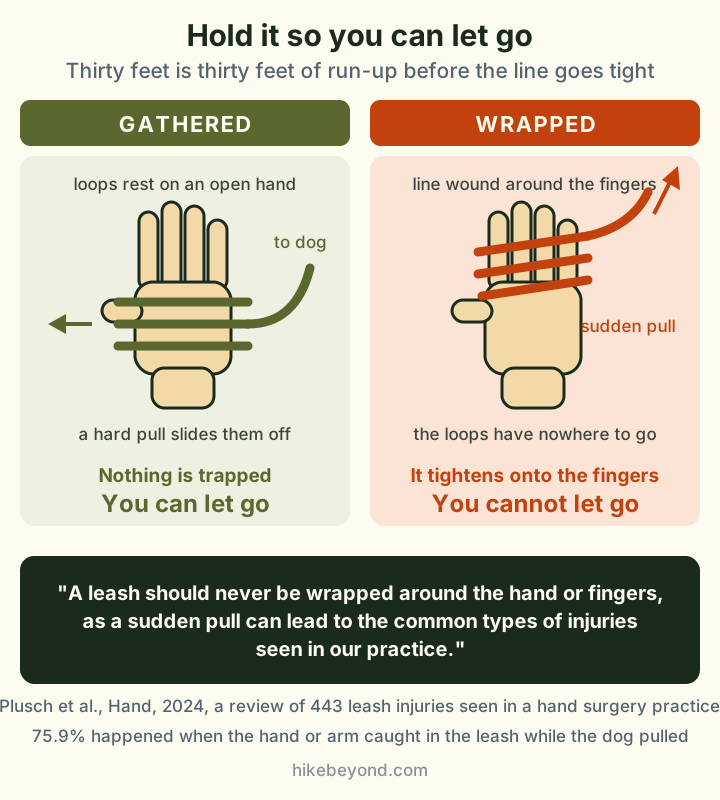
What the hand clinic data shows. A separate study of 443 patients who came to a hand surgery practice with a leash injury found that 75.9% happened when the hand or arm caught in the leash while the dog pulled. Those authors put their conclusion bluntly:
“A leash should never be wrapped around the hand or fingers, as a sudden pull can lead to the common types of injuries seen in our practice.” Plusch et al., Hand, 2024
What neither shows. Neither records what kind of leash was involved. A 2024 review in the Journal of the American Veterinary Medical Association notes that leash type is simply not in the data. So there is no study saying long lines are more dangerous than other leashes, and this article does not claim one. The full data is in Hands-Free Leashes.
What is specific to a long line is distance. Thirty feet is thirty feet in which a dog can accelerate before the line goes tight. That is mechanical reasoning, not a measured finding, and it is offered as such.
The four handling rules
Never wrap it around your hand, wrist or fingers. This is the one with a published recommendation behind it, quoted above.
Hold it in loops you can let go of. Loose gathered loops in an open palm, not a coil wound round the hand.
Watch your own legs. A line running behind your knees while a dog circles is how people end up on the ground. Step over it or move, rather than letting it wrap.
Let go rather than fight it. If a dog is going to hit the end at speed, dropping the line costs you a recall. Holding on can cost you a finger or your balance.
Using one well
- Attach it to a well-fitted back-clip harness, which is what the AKC recommends, to keep a pulling dog from straining its neck
- Hold the line in loose loops you can drop, never wrapped
- Bring the dog in by gathering the line as you walk toward it, not by pulling
- Use an open area with room for the dog to run, as the AKC advises
- Keep the slack off the ground when passing people, dogs, horses or bikes
- Shorten up before blind corners
- Skip it where there is dense undergrowth to snag on, or a drop nearby
- Check the clip and the stitching for wear before a trip
Shorten by gathering, not by pulling. Take in loops as the dog comes toward you, so there is never a long section of loose line at your feet.
Which line to buy
| Feature | What to look for |
|---|---|
| Length | The AKC range is 10 to 50 feet, with 20 or 30 feet suggested for recall training. Shorter is easier to manage on a trail, longer suits open ground |
| Material | Nylon or biothane, both named by the AKC. Flat webbing is kinder to hands than round rope, and biothane does not absorb water |
| Width | Wide enough to hold comfortably. A thinner line concentrates the same load on less skin |
| Clip | Check it, and the stitching at both ends, for wear before a trip |
| Handle loop | Optional, and a loop is one more thing that can catch on a branch or on your hand. If yours has one, that is a reason to be deliberate about not putting your hand through it |
What not to pay extra for: a reflective long line. A line lying on the ground is not what needs to be seen after dark, the dog is. See LED Safety Lights.
Where a long line is the wrong choice
- Anywhere the rules cap leash length, which includes all National Park Service land
- Narrow busy trails: there is nowhere for thirty feet of line to go
- Dense undergrowth: it will snag, and you will spend the walk untangling
- Near cliff edges or water hazards: the distance that makes it useful becomes the problem
- With a dog that lunges hard at wildlife: the line goes tight at the worst moment, for both of you
Common questions
Is a long line legal on trails?
Often not. In National Park Service areas, 36 CFR 2.15(a)(2) requires a leash no longer than six feet, which every long line exceeds. Other agencies and local authorities set their own rules, and the AKC advises checking local ordinances because some places do not permit leashes longer than six feet. Check the regulations for the specific area.
Long line or retractable?
Long line, for trail use. The AKC notes that a retractable has a thin cord that is hard to see, especially at night, that can burn or cut as it crosses skin, and a handle that will chase the dog if you drop it. Trainers use plain long lines.
Should I attach it to a collar or a harness?
A harness. The AKC specifically recommends a well-fitted back-clip harness with a long line, so a dog that pulls is not straining its neck.
What length should I get?
The AKC describes long lines as ranging from 10 to 50 feet, and suggests 20 or 30 feet for recall training. Shorter lines are easier to keep out of trouble on a trail, longer ones need open ground and practice.
How do I stop it tangling?
Keep the slack gathered rather than trailing, shorten up before corners and when passing others, and avoid dense undergrowth entirely. Flat biothane tangles less than round rope.
Continue exploring
Sources
- US National Park Service pet regulation, 36 CFR 2.15(a)(2), the six foot maximum leash length, read verbatim. Text at Cornell Legal Information Institute
- American Kennel Club, Is Your Dog Ready To Be Off-Leash? long lines of 10 to 50 feet in nylon and biothane, the back-clip harness recommendation, using an open area, and checking local ordinances for leashes longer than six feet.
- American Kennel Club, How to Train Your Dog to Come When Called graduating to a 20 or 30 foot long line, and gathering the line rather than reeling the dog in.
- American Kennel Club, Retractable Dog Leashes: When and How to Use Them Safely thin cords being hard to see, able to burn or cut as they cross skin, and a dropped handle chasing the dog.
- Leash injury data, the Johns Hopkins emergency department analysis and Plusch et al., Hand (2024), is set out with its sources in Hands-Free Leashes.
HikeBeyond is an information resource. Leash length rules vary by location, check the regulations for the area you are hiking.
Save this for later
Pin this to come back to it, or to send it to someone heading out with a dog.